
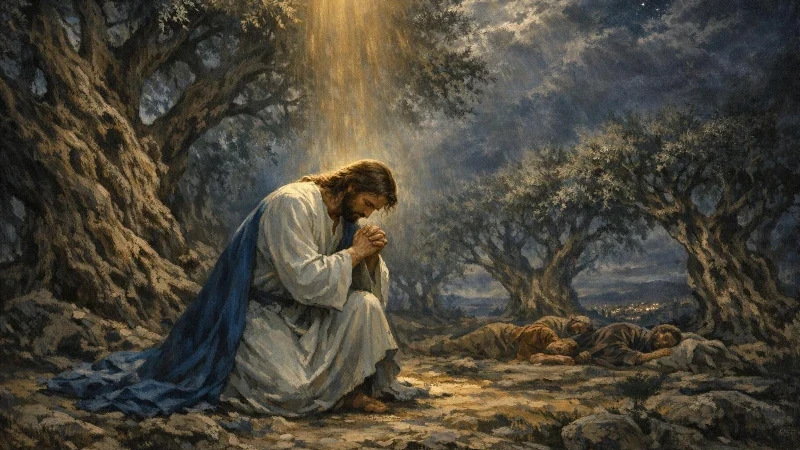
Blessings, beloved family of faith. As a worker who has no need to be ashamed and who correctly handles the word of truth, we draw near today to the garden of Gethsemane. May the Holy Spirit enlighten our hearts to understand the depth of the sacrifice of our Lord.
Bible Text: Mark 14:32-42 (Reina-Valera 1960)
32 And they came to a place which was named Gethsemane: and he saith to his disciples, Sit ye here, while I shall pray. 33 And he taketh with him Peter and James and John, and began to be sore amazed, and to be very heavy; 34 And saith unto them, Mysoul is exceeding sorrowful unto death: tarry ye here, and watch. 35 And he went forward a little, and fell on the ground, and prayed that, if it were possible, the hour might pass from him. 36 And he said, Abba, Father, all things are possible unto thee; take away this cup from me: nevertheless not what I will, but whatthou wilt. 37 And he cometh, and findeth them sleeping, and saith unto Peter, Simon, sleepest thou? couldest not thou watch one hour? 38 Watch ye and pray, lest ye enter into temptation; the spirit truly is ready, but the flesh is weak. 39 And again he went away, and prayed, and spake the same words. 40 And when he returned, he found them asleep again, (for their eyes were heavy,) neither wist they what to answer him. 41 And he cometh the third time, and saith unto them, Sleep on now, and take your rest: it is enough, the hour is come; behold, the Son of man is betrayed into the hands of sinners. 42 Rise up, let us go; lo, he that betrayeth me is at hand.5 Fundamental Truths That Gethsemane Teaches Us.The Humanity of Christ: In Gethsemane we see a Jesus who is fully man, experiencing dread and deep anguish, which makes him our compassionate High Priest.
The Nature of Temptation:
- Temptation seeks to make the believer choose the path of immediate relief over the path of sacrificial obedience. In Gethsemane we see a Jesus fully human, experiencing dread and deep anguish, which makes him our compassionate High Priest.
- The Nature of Temptation: Temptation seeks to make the believer choose the path of immediate relief over the path of sacrificial obedience.
- The Priority of Divine Sovereignty: Prayer is not a means to change God's will, but to align our heart with His eternal purpose.
- The Weakness of the Flesh: Without spiritual vigilance (watching), even the most faithful disciple is vulnerable to denying his Lord under pressure.
- Victory in Surrender: True victory over sin and death began with a bended knee and a surrendered will before reaching the cross.
Introduction.
Let us imagine for a moment an athlete who has trained his whole life for the final race. He knows the route, he knows there will be pain, but when he reaches the starting line and sees the magnitude of the mountain he must climb, his legs tremble. We have all been in a personal “Gethsemane”: that waiting room in a hospital, the night before a decision that will change our life, or the moment when we must accept an irreparable loss.
Gethsemane means “oil press.” It was a place where olives were crushed under immense weight to extract the purest oil. That night of Maundy Thursday, our Savior was “crushed” not yet by the sin of others, but by the weight of obedience. His agony was not a lack of faith, but the full awareness of the cost of our redemption. Jesus did not go to the cross as a stoic without feelings, but as a Lamb who felt every drop of anguish, teaching us that spiritual maturity is not the absence of fear, but the presence of trust in the Father despite fear.
Biblical Exposition.
1. The real anguish of Jesus (Mark 14:33-34) Mark uses extremely strong Greek words: ekthambeistai (terrifying dread) and ademonein (extreme anguish). Jesus tells them: “My soul is deeply grieved, to the point of death.” Luke adds that His sweat was like great drops of blood. This condition, known as hematidrosis, occurs under extreme emotional stress. Why such dread? It was not only the fear of physical nails; it was the horror of knowing that He, who never knew sin, would become sin for us and would drink the cup of God's wrath.
2. The model prayer: “Not my will, but yours” (Mark 14:35-36) Jesus' prayer begins with astonishing intimacy: “Abba, Father”. In the midst of terror, His identity as Son does not change. Jesus presents an honest plea: “take this cup away from me.” God does not ask us to pretend that pain does not hurt. But the key to total surrender is in the “but”: “yet not what I want, but what you want”. Here, Jesus reverses Adam's rebellion in Eden. While Adam said, “My will and not yours,” the Second Adam says, “Your will and not mine.”
3. Lessons for crisis: Watch and pray (Mark 14:37-40) Jesus seeks support from His closest friends, but finds them sleeping. The warning is clear: “Watch and pray, so that you do not enter into temptation”. The temptation in times of crisis is to seek escape (sleep, denial, isolation). The flesh is weak and cannot sustain the purposes of the spirit on its own. Prayer is the supply of power needed so that what the spirit desires, the flesh can carry out.
Conclusion.
Gethsemane teaches us that the place of our greatest anguish can become the place of our greatest victory if we are willing to surrender. Jesus came out of prayer with unshakable determination. He was no longer seeking for the cup to pass; He was ready to drink it.
Prayer: Beloved Father, we come before You acknowledging that many times we have fought against Your will. Thank You for Jesus, who in Gethsemane chose to love us above His own relief. Today we surrender to You our own “cups” of pain, our doubts, and our fears. Help us to watch and pray, so that in the hour of trial we do not fall asleep in complacency, but rise up in Your power. Your will be done in our lives, as in heaven. Amen.
Did you find this article helpful? Mark us as your preferred source on Google and get our content first.