
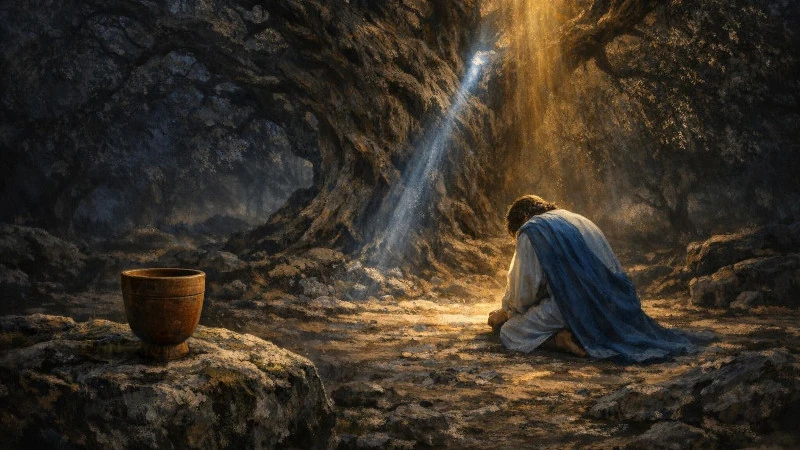
May the grace and peace of our Lord Jesus Christ be with each one of you. As workers who have nothing to be ashamed of, today we approach one of the most sacred and profound moments in the history of redemption: the agony of our Savior in the garden of Gethsemane. May the Holy Spirit guide our study and surrender our hearts to His will.
Matthew 26:36-42
“36 Then Jesus came with them to a place called Gethsemane, and said to His disciples, 'Sit here while I go over there and pray.' 37 And taking Peter and the two sons of Zebedee with Him, He began to be sorrowful and deeply distressed. 38 ThenJesus said to them, 'My soul is deeply grieved, to the point of death; stay here and keep watch with Me.' 39 Going a little farther, He fell on His face, praying and saying, 'My Father, if it is possible, let thiscup pass from Me; yet not as I will, but as You will.” 40 Then He came to His disciples and found them sleeping, and said to Peter, 'So, could you not keep watch with Me for one hour? 41 Keep watching and praying, so that you do not enter into temptation; the spirit is willing, but the flesh is weak.' 42 He went away again a second time and prayed, saying, 'My Father, if this cup cannot pass away unless I drink it, Your will be done.'"
Introduction.
A few years ago, during a pastoral visit to a family going through a devastating financial and health wilderness, the father told me with tears: “Pastor, I feel like life is crushing me, as if I were in a press where nothing of me is left.”. At that moment, we remembered together the meaning of the word Gethsemane. In the ancient world, to obtain the purest olive oil, the olives had to be subjected to immense pressure under a large millstone. Without pressure, there is no oil; without brokenness, there is no anointing.
Jesus, the “Light of the World,” voluntarily chose to enter the press. It was not a historical accident, but a divine appointment. While the city of Jerusalem slept after the Passover meal, in the darkness of the olive grove, the greatest battle in history was being fought: the battle of the will. We all face our own “Gethsemanes,” those places of decision where what we want clashes with what God has determined. How will we respond when the cup is bitter?
Historical Context
Gethsemane was an olive grove located at the foot of the Mount of Olives, across the Kidron Valley. It was a frequent place of retreat for Jesus. However, this night was different. The shadow of Judas's betrayal and the imminence of the cross weighed heavily on the atmosphere. Jesus was not simply afraid of physical death—many martyrs have died with courage—He feared “the cup,” which in the Old Testament symbolizes God's wrath against sin (Psalm 75:8).
Textual analysis and central truths.
1. The Honesty of Anguish (vv. 37-38) Jesus did not hide His pain. Taking Peter, James, and John, He opened His heart to them: “My soul is deeply grieved, to the point of death”. Here we see the Central Truth 1: Faith does not exclude pain. Praying is not pretending that we are fine, but pouring out our reality before the Father. Jesus' anguish was the weight of bearing the iniquity of all of us.
2. The Petition vs. Submission (v. 39) Jesus' prayer is the perfect model of balance. He asks: “if it is possible, let this cup pass from Me”. This teaches us that we can ask for relief. But He immediately adds: “yet not as I will, but as You will”. Central Truth 2: The purpose of prayer is not to move God's hand toward our desires, but to move our heart toward His purposes. The victory was won when the “I” of Christ's humanity surrendered to the “You” of the Father's sovereignty.
3. The Call to Vigilance (vv. 40-41) While the Savior sweat drops of blood, His friends slept. Jesus warns them that prayer is the only antidote against falling. Central Truth 3: The lack of prayer leaves us unprotected against temptation. The disciples failed in the garden because they slept; Peter would deny Jesus hours later because he did not keep watch in Gethsemane.
Application.
Today, this word challenges us to:
- Identify our “cup”: Accept that there are painful processes that God will not remove, but that will give us the grace to drink.
- Keep watch in community: Do not underestimate our carnal weakness; we need to seek God fervently before the trial comes.
- Surrender the will: Change our prayers from “Lord, do this” to “Lord, do with me as You wish.”.
Conclusion.
In Gethsemane we learn that God's silence is not God's absence. The Father did not remove the cup, but He sent angels to strengthen the Son. Likewise, God may not remove your problem today, but He will give you the strength to overcome it. Jesus left Gethsemane with an unshakable peace to face the trial and the cross.
Prayer: Heavenly Father, we thank You for the example of obedience of our Lord Jesus. Forgive us for the times we have preferred our comfort over Your will. Today we surrender our anxieties in Your presence. Give us a watchful spirit so that we do not fall into temptation and the strength to say, with all our heart: Your will be done in my life, in my family, and in my health. In the name of Jesus, Amen.
Did you find this article helpful? Mark us as your preferred source on Google and get our content first.