
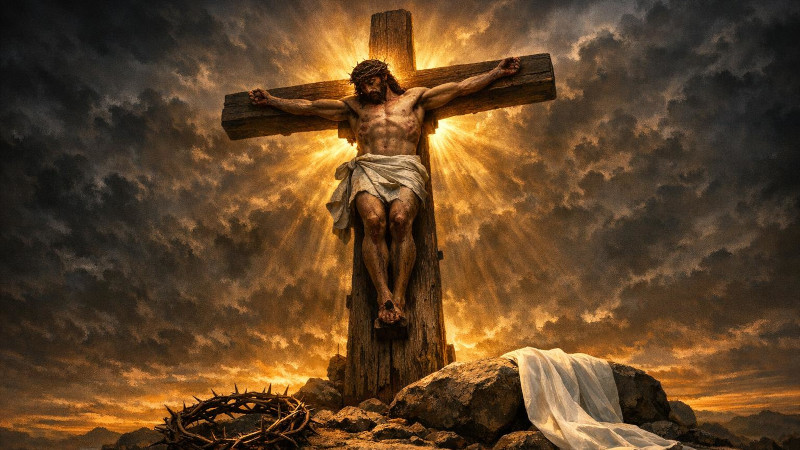
May the grace and peace of our Lord Jesus Christ flood your hearts. As workers who have nothing to be ashamed of and who rightly handle the word of truth, we prepare ourselves to meditate on the climactic moment in the history of redemption: the sacrifice at Calvary.
Bible Texts: Luke 23:33-34, 43; John 19:26-27, 28, 30; Matthew 27:46; Luke 23:46.
“And when they came to the place called the Skull, they crucified Him there... And Jesus was saying: Father, forgive them, for they do not know what they are doing.“ (Luke 23:33-34)
“Jesus said to him: Truly I tell you, today you will be with me in paradise.“ (Luke 23:43)
“When Jesus saw His mother and the disciple whom He loved... He said to His mother: Woman, here is your son. Then He said to the disciple: Here is your mother.“ (John 19:26-27)
“About the ninth hour, Jesus cried out in a loud voice, saying: Eli, Eli, lema sabachthani? That is: My God, my God, why have you forsaken me?“ (Matthew 27:46)
“After this, knowing that everything had now been accomplished... Jesus said: I am thirsty.“ (John 19:28)
“When Jesus had received the sour wine, He said: It is finished.“ (John 19:30)
“Then Jesus, crying out in a loud voice, said: Father, into your hands I commit my spirit.“ (Luke 23:46)
Introduction.
Imagine a king who, instead of issuing decrees from a golden throne, decides to dictate his most important law while being unjustly executed by those he came to save. In ancient times, a man's last words were considered his final testament, the essence of his character.
I remember a hospital visit to an elderly believer in his final minutes. He did not ask for possessions; he only whispered, “Christ is faithful.” If the words of a dying man carry weight, how much more do the words of the Son of God on the altar of the cross? The Seven Words are not the complaints of a victim, but the proclamation of a Conqueror. Each phrase is a step on the ladder of our redemption, connecting heaven with our earthly misery.
The Sermon of the Seven Words was not a structured speech in a synagogue, but the cry of the Lamb of God as He took away the sin of the world. Here we present 5 fundamental truths:
- The Sufficiency of the Sacrifice: On the cross, Christ fulfills the Law and the Prophets, establishing a new covenant in His blood.
- Continual Intercession: His first word is one of forgiveness, revealing His role as our eternal High Priest.
- Sovereignty in Suffering: Even nailed to the wood, Jesus exercises His authority to save souls (the thief) and to set His house in order (Mary and John).
- Penal Substitution: The cry of abandonment shows Christ bearing our separation from God so that we might never be forsaken.
- The Consummated Victory: The “Tetelestai” (It is finished) is not a sigh of relief, but a shout of legal triumph over sin and death.
Biblical Exposition: The Heart of the Atonement
1. The Historical and Theological Context Crucifixion was the most shameful method of execution in the Roman Empire, designed to maximize pain and public humiliation. Theologically, Christ is under the curse of the law (Galatians 3:13). Yet in this scene of physical and spiritual darkness, the Light of the World emits seven flashes of divine revelation.
2. Central Truths
- Point I: The Reach of Grace (Words 1, 2, and 3) Jesus begins by looking outward. He asks forgiveness for His enemies, demonstrating that grace has no limits. Then He saves a repentant criminal, reminding us that it is never too late for mercy. Finally, He provides care for His mother, sanctifying family bonds and the responsibility of love within the community of faith.
- Point II: The Price of Sin (Words 4 and 5) Here we enter into the “Holy of Holies” of sorrow. The cry of abandonment (Why have you forsaken me?) reveals the mystery of propitiation: the Father turns His face away from the Son because the Son is bearing our iniquity. His physical thirst (Word 5) fulfills Scripture (Psalm 69:21) and shows us His real humanity; He thirsted so that we might drink from the Water of Life.
- Point III: The Certainty of Victory (Words 6 and 7) “It is finished” is a single word in Greek: Tetelestai. It was used in commerce to say “the debt is paid in full.” The work of salvation was not left incomplete. Finally, the seventh word is an act of absolute trust. Jesus does not “die” by accident; He voluntarily gives up His spirit to the Father, opening the way for us to do the same.
3. Application. How do we live this out today? By forgiving those who do not deserve it (like Christ), trusting that our debt is paid (without trying to “buy” heaven), and surrendering our spirit daily to God's control.
Conclusion.
We have walked the road of Golgotha and heard the heart of the Master. These seven words form the bridge over the abyss of our separation from God. There is no sin so great that “Father, forgive them” cannot cover, nor a life so broken that “You will be with me” cannot restore.
Prayer: Lord Jesus, thank You for speaking when silence would have been easier. Thank You because Your pain produced our comfort. Help us to live under the shadow of these words, being ambassadors of Your forgiveness and witnesses of Your finished victory. Amen.
Did you find this article helpful? Mark us as your preferred source on Google and get our content first.